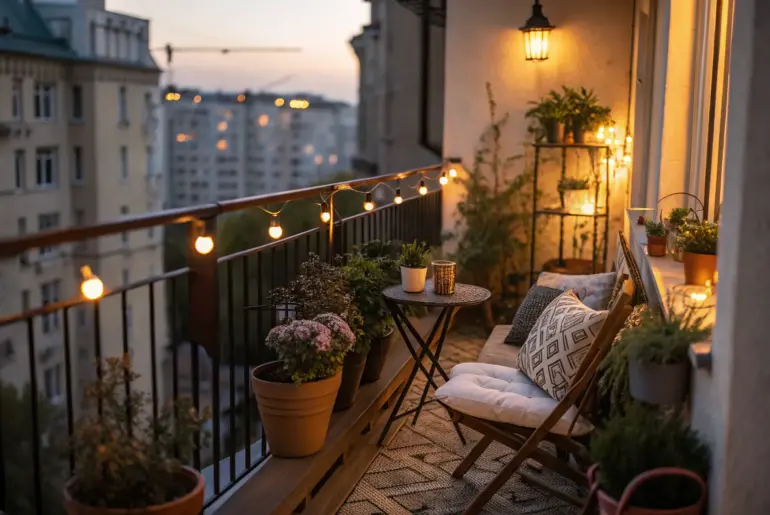
Small balconies hold enormous potential. With thoughtful styling, they can become miniature outdoor rooms—serene extensions of your living space designed for relaxation, greenery, and light.
Start by Defining the Purpose

Every design decision begins with clarity of purpose. Ask: What do I want this balcony to do? Your answer might influence every choice that follows:
- Morning retreat – Prioritize sunlight, soft textiles, and café-style seating.
- Urban garden – Focus on vertical greenery and weather-tolerant planters.
- Mini dining area – Choose collapsible furniture and ambient lighting.
- Extended workspace – Opt for modular benches and portable shade.
Once the purpose is clear, size and proportion guide the design. I often sketch the balcony footprint first, adding functional “zones” (e.g., one for seating, one for plants) before considering materials or decor.
Understand Your Constraints

Balconies come with physical and environmental limits—load-bearing capacity, sunlight exposure, privacy, and local regulations. Before styling, assess these parameters:
| Constraint | What It Affects | Smart Solution |
|---|---|---|
| Sunlight | Plant selection, seating comfort | Use shading fabrics or UV-resistant materials. |
| Wind | Furniture stability, decor durability | Anchor tall pieces or use heavier bases. |
| Weight restrictions | Flooring, planters, furniture | Choose lightweight composites or fiber cement pots. |
| Privacy | Comfort, usability | Add lattice panels, outdoor drapes, or slim hedges. |
Treat this step like an architectural survey—not limiting, but empowering. Once you know your boundaries, design becomes much freer.
Build the Foundation: Flooring & Structure

The floor defines the atmosphere of any small balcony. I recommend creating a visual base that blends with your interior flooring for continuity.
Popular outdoor surfaces for compact balconies:
- Interlocking deck tiles: Easy to cut, remove, and clean—great for renters.
- Composite slats: Drain quickly, resist fading, and add warmth underfoot.
- Outdoor rugs: Perfect for defining zones; select quick-dry and UV-resistant fibers.
Tip: Test materials in sunlight—colors can shift dramatically under direct UV exposure. Warmer neutrals tend to age more gracefully.
Choose Scaled and Flexible Furniture

Compact outdoor rooms depend on proportion. Full-size loungers can overwhelm; slim silhouettes or foldable designs create balance.
Space-saving strategies:
1. Multi-functional pieces – A storage bench doubles as seating and a planter platform.
2. Drop-leaf tables – Collapse them when not in use.
3. Wall-mounted bar shelves – Ideal for coffee or laptop work.
4. Stackable stools – Provide extras for guests without permanent clutter.
To create comfort without visual heaviness, I often rely on open-frame furniture—metal or slatted wood—so air and light flow through.
Layer Textures & Textiles

Soft elements make a small balcony feel intentional rather than improvised. Use textiles as both design anchors and comfort enhancers.
- Textile palette: Recycle your interior scheme—if your living room carries warm neutrals, extend that palette outdoors with taupe, sand, and rust.
- Weather protection: Look for outdoor-rated fibers made from solution-dyed acrylic or olefin to resist fading and mildew.
- Layering trick: Combine a textured floor rug, slim cushions, and one throw blanket—it adds both physical and visual warmth.
Introduce Vertical Greenery
When floor space is tight, the only way is up. I often integrate planting in vertical layers for depth and movement.
Vertical garden ideas:
- Modular planting grids with integrated irrigation.
- Narrow railing planters or wall-hung pots.
- Tall containers with upright growth habits (e.g., bamboo, rosemary, or ornamental grasses).
Sample planting composition (for a sunny balcony):
| Layer | Example Plants | Height Range |
|——-|—————-|————–|
| Tall backdrop | Fountain grass, potted olive tree | 24–36 in. |
| Mid layer | Lavender, coleus, sweet alyssum | 10–18 in. |
| Trailing front | Ivy, verbena, trailing petunia | 6–12 in. |
This tiered structure maximizes soil depth and makes watering more efficient. If you have partial shade, substitute shade-loving herbs such as mint, oregano, and chives.
Play With Lighting & Atmosphere
Lighting transforms even the simplest balcony. Think glow, not glare. You want enough illumination for evening use, but still soft on the eyes.
- Solar string lights: Effortless and energy-efficient.
- Rechargeable lanterns: Portable and decorative.
- Candle groupings: Create cozy, flickering warmth (choose LED for safety).
- Indirect wall lights: Useful for subtle vertical illumination without cluttering limited surfaces.
Designer tip: Focus lights on corners or upward-facing features—it visually expands the space and defines architectural lines.
Maintain Comfort Through Seasons
A great balcony functions year-round, not just in summer. Extend usability by adapting to changing weather:
| Season | Adjustments |
|---|---|
| Spring | Add layered planting and pollinator-friendly flowers. |
| Summer | Use linen covers and shade sails. |
| Autumn | Incorporate warmer textiles and solar lighting. |
| Winter | Swap for hardy evergreens and outdoor-safe lanterns. |
Even minor updates—like changing pillow covers or bringing in evergreen cuttings—keep the balcony visually fresh and emotionally engaging.
Weaving It All Together
When I style a balcony, I treat it as I would a small living room: a story told through materials, light, and function. Start with purpose, clarify the constraints, and layer design elements intentionally. Every square foot can work harder when planned with care.
Your balcony doesn’t need to be large to feel generous—it only needs thoughtful design and a sense of belonging to the home it extends.