Every home is a living conversation between order and freedom. Understanding whether your natural rhythm aligns with soft order or hard order helps you create a home that’s not only beautiful but emotionally balanced.
Understanding the Two Faces of Order

Order in interiors isn’t about perfection—it’s about intention. The difference lies in how you create and maintain structure.
Soft order allows space for human presence—motion, warmth, and daily change. It’s guided by emotion and intuition more than rules. Soft-ordered interiors often show signs of life: a slightly askew stack of magazines, a favorite bowl now holding fruit instead of keys. Everything appears intentional, even when it moves.
Hard order, in contrast, anchors a home in precision. It’s about logic, repetition, and structural truth. Lines align. Colors repeat. A well-considered layout keeps visual noise at bay. It evokes calm through clarity—an environment where focus and control shape the atmosphere.
| Aspect | Soft Order | Hard Order |
|---|---|---|
| Visual rhythm | Organic and fluid | Geometric and consistent |
| Energy flow | Movement allowed | Controlled and still |
| Emotional tone | Comforting, approachable | Grounded, refined, focused |
| Maintenance level | Adaptive and casual | Intentional and maintained |
| Example | A collected gallery wall with mixed frames | A minimalist layout with aligned frames |
The Psychology Behind Your Preference

Our brains organize space based on comfort thresholds. Research in environmental psychology shows that people interpret clutter or alignment through emotional filters rather than objective standards. Hard order can support cognitive focus, while soft order enhances emotional well-being and creativity.
Ask yourself:
- Do asymmetries make you uneasy or intrigued?
- Do you feel energized by open surfaces or by meaningful clusters?
- When guests visit, do you “tidy up” or simply adjust lighting and scent?
Recognizing your instinct is the foundation of spatial authenticity. I often remind myself: a space that reflects your natural rhythm is easier to sustain than one that constantly resists it.
Designing with Soft Order

Soft order thrives on sensory layering and fluid transitions. It’s ideal for those who like rooms to evolve organically without losing style.
Visual Strategy:
- Start with a calm core. Ground the room with one neutral anchor—perhaps a rug, a sofa, or wall tone—then let smaller décor choices play around it.
- Layer lighting. Combine diffuse, directional, and reflective light sources. This flexibility mimics the way natural light shifts through the day.
- Create deliberate asymmetry. Position furniture slightly off-center or vary frame sizes on a wall. This encourages the eye to wander, not fixate.
- Rotate styling elements. Keep one surface—like a console or coffee table—as a “living vignette” that changes monthly.
Practical Example:
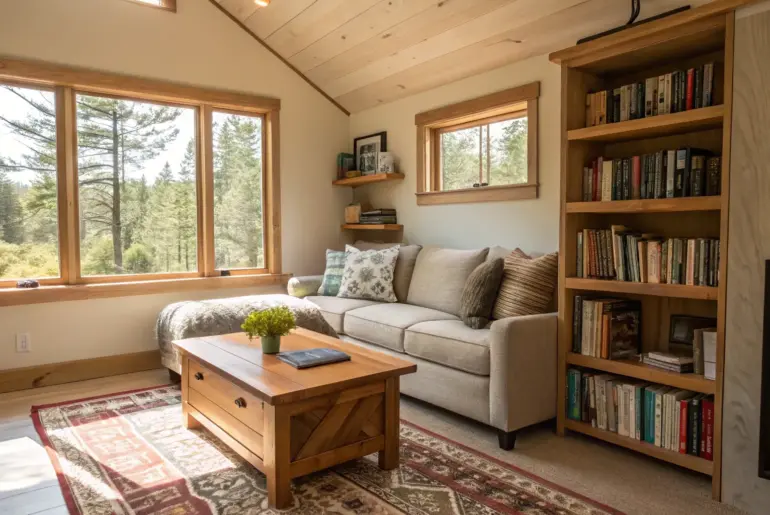
A soft-ordered living room may pair a round coffee table with offset armchairs, a vintage lamp slightly off alignment, and books interspersed with vessels and candles. The space invites touch, conversation, and adaptation.
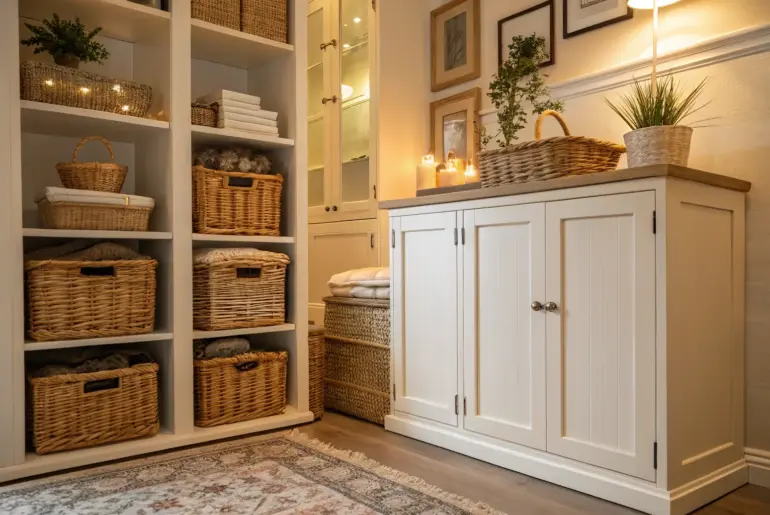
Tip: Use open baskets and low trays to create flexible containment. This merges psychological order with visible spontaneity.
Designing with Hard Order

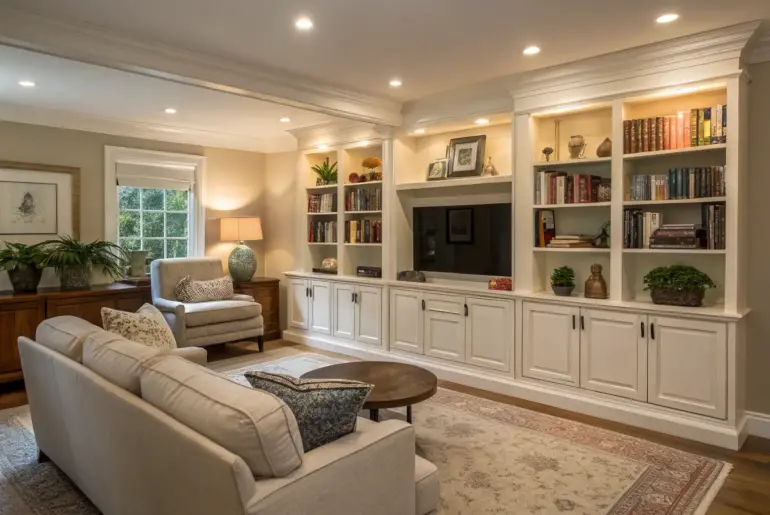
Hard order relies on clarity and repetition. It doesn’t mean sterile minimalism—it’s about purpose-driven placement. A well-ordered room feels collected, not cold.
Core Principles:
1. Map the grid. Sketch your room into thirds, both horizontally and vertically. Let this invisible framework guide your placement of furniture, art, and lighting.
2. Apply chromatic discipline. Choose no more than four hues (two neutrals, one dominant, one accent). This builds cohesion and visual control.
3. Use contrast as punctuation. If your space relies on structured alignment, a single organic element (a driftwood sculpture, a branch in a vase) functions as relief.
4. Establish maintenance rituals. Hard order only works when supported by routine—weekly resets, defined storage, no arbitrary items left on surfaces.
Design Exercise:
Try styling one corner with the “5x rule”: for every five objects, remove one. The subtraction amplifies harmony and sharpens focus.
Tip: Reintroduce warmth through tactility—matte finishes, grainy woods, or woven textures soften geometric control.
Blending the Two Worlds

Most real homes need a dialogue between the two systems. Hard order builds the skeleton; soft order adds pulse. The relationship can shift depending on zones or moods.
Balanced Applications:
- Hard-base, soft-applied: A symmetrical dining setup (table, chairs, pendant centered) enhanced by shifting table décor like linen runners or handmade plates.
- Soft-base, hard-framed: A creative studio anchored by storage grids and shelving, giving freedom elsewhere.
- Kitchen contrast: Structured cabinetry with open countertops styled loosely—fruit in ceramics, textiles folded casually.
| Room Type | Emphasis | Balancing Element |
|---|---|---|
| Living Room | Soft order for comfort | Geometric rug or aligned lighting |
| Kitchen | Hard order for function | Open shelves styled intuitively |
| Bedroom | Soft order for intimacy | Structured symmetry in bed frames |
| Home Office | Hard order for clarity | Organic green elements for ease |
Case Reflection: When Soft Order Becomes Sustainable
In many homes, design begins as hard order—perfect corners, defined shelves, aligned artwork—and gradually relaxes into soft order as life fills the gaps. I’ve seen this transition countless times: the stack of notebooks on a desk grows, the vase moves slightly off-center, and suddenly the space feels alive, not staged.
That’s the insight worth holding onto—good design isn’t static. It’s rhythm and resonance. Allowing for both kinds of order means your home remains responsive to you.
How to Find Your System
- Observe your habits. Watch how you naturally leave spaces—what stays consistent, what drifts.
- Assign levels of control. Hard for practice (kitchen, work zones); soft for presence (living, bedroom).
- Set daily “reset rituals.” A five-minute evening pass restores order suited to your system—lining edges for hard order, smoothing textures for soft.
- Revisit seasonally. As light, energy, and routines change, so might your tolerance for structure.
Tip: Photographing your home each month provides perspective. You’ll notice patterns of order and disarray that reveal what truly works for you.
Living the Balance
A home anchored in its owner’s natural order radiates calm. It becomes a silent support system—neither demanding constant upkeep nor collapsing into chaos.
Order isn’t about control; it’s about rhythm. A linear shelf can hold asymmetrical objects and still feel balanced. A loosely layered bed can rest over a perfectly aligned rug. The coexistence of these nuances is what gives a home depth, identity, and peace.